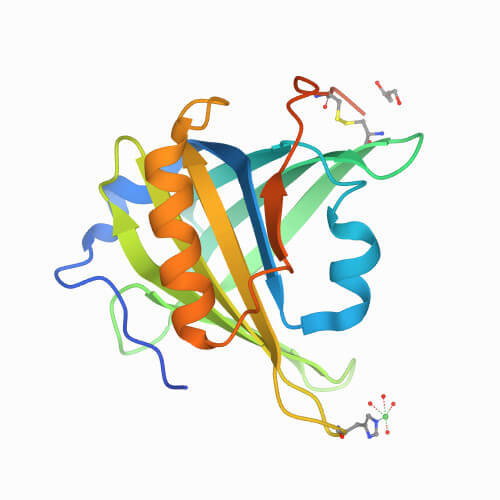
PAPP-A, which was first isolated in human pregnancy serum, belongs to the metzincin superfamily of metalloproteinases. PAPP-A circulates in pregnancy as a heterotetrameric disulfide-bound 2:2 complex composed of two 200 kDa PAPP-A subunits and two 50-90 kDa proform of eosinophil major basic protein (pro-MBP) subunits, denoted as PAPP-A/proMBP (~500kDa). Both PAPP-A and proMBP are synthesized in the placenta during pregnancy. Serum PAPP-A concentration increases exponentially throughout pregnancy until delivery and attains maximum levels at term. Heterotetrameric PAPP-A is highly efficient as a serum marker in first-trimester screening for Down’s syndrome (trisomy 21) and other fetal aneuploidies since low maternal serum levels have been associated with them. There is mounting evidence that low PAPP-A levels in the first trimester are also linked to adverse pregnancy outcomes such as preterm delivery, intrauterine growth retardation, preeclampsia, and stillbirth. Homodimeric PAPP-A also exists in serum, which circulates as a homodimer, not in complex with pro-MBP and associated with acute coronary syndrome (ACS) and other cardiac conditions.
Pregnancy Associated Plasma Protein A (PAPP-A) Antigen (liquid)
Product Code : 00-AGN-AP-PPA-001
Specifications:
| Parameters | Acceptance Criteria |
|---|---|
| Physical Appearance | Colorless liquid |
| PAPP-A Concentration | ≥ 0.5 mg/ml by DRG ELISA , ≥ 100000mIU/L by Auto Delfia Assay |
| Total Protein Concentration | Batch specific |
| Purity | ≥ 95% by SDS-PAGE |
| SDS PAGE | Single band corresponding to Mol. Wt. of 200 KD |
| Buffer | Tris-10mM at pH 7.4 ± 0.2 containing NaCl-150mM, NaN3 0.09% and 0.1% NGME |
| Anti HIV1&2 | Negative (ELISA Assay) |
| Anti HCV | Negative (ELISA Assay) |
| HBsAg Antigen | Negative (ELISA Assay) |
| HBV DNA (PCR) | Not Detected (PCR Analysis) |
| HCV RNA (PCR) | Not Detected (PCR Analysis) |
| HIV DNA (PCR) | Not Detected (PCR Analysis) |
| Source of the product | Human Placenta |
| Storage temp | -20º C |
| Shelf life | 2 years |
For research use or further manufacturing purposes only